

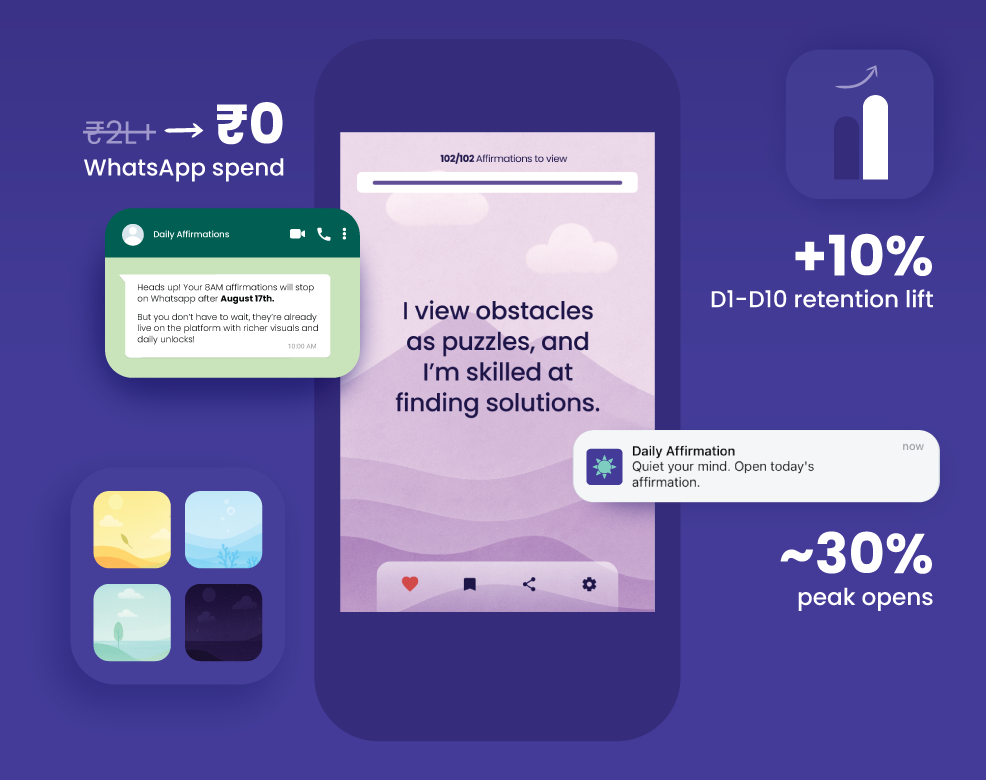
Why This Project
Affirmations had quietly become a loved feature on the platform. Our WhatsApp pilot showed surprising demand: 1,092 monthly users and 27,000 messages sent at a 60% read rate, and a survey of 204 subscribers rated it 8/10 on “would recommend”. But it came with a ₹2.6L annual bill (about ₹21,900 a month) and little control over the experience. The platform version existed, but felt flat and one-time: users binged multiple affirmations at once and rarely returned.
From the wider platform data, we also saw a shift in mental health behaviour: users were moving from crisis-first care toward preventive, daily wellness rituals. Affirmations fit perfectly into this proactive space.. light, daily, habit-driven.
And the audience fit was clear: a majority of all sessions came from 21-30 year olds (young professionals and students), the very group most open to small digital rituals woven into their day.
We believed affirmations could be more: a calming, habit-building ritual that lives inside the platform, supported by thoughtful design and nudges.


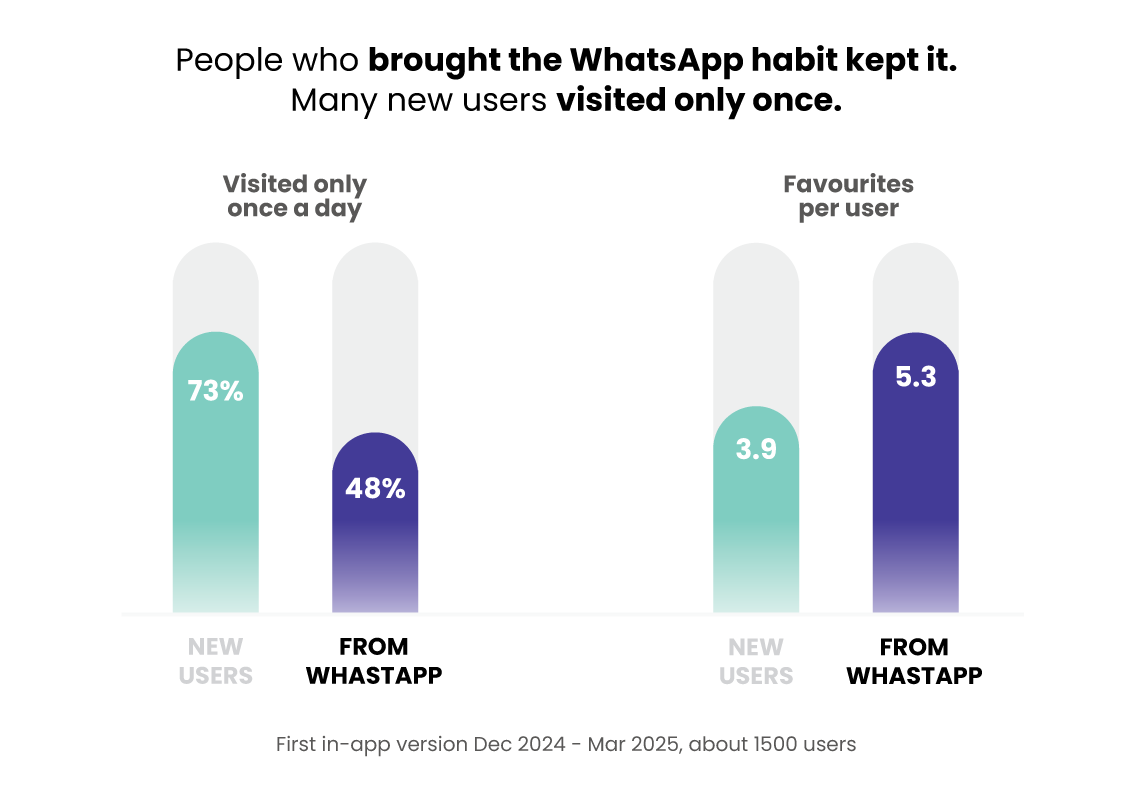
What the first in-app version taught us: In its first three months, about 1,500 people used the in-app version, viewing around 21,000 affirmations.
But 73% of new users came on only one day. People who’d moved over from WhatsApp behaved differently: fewer one-day visits, and more favourites saved (5.3 each against 3.9).
The habit existed, but the app wasn’t building it for newcomers. And in-app opens already peaked between 7:30 and 8:30 AM, which confirmed the morning was the moment to design for.
The Challenge
When we analysed data and spoke with counsellors, these themes came up:
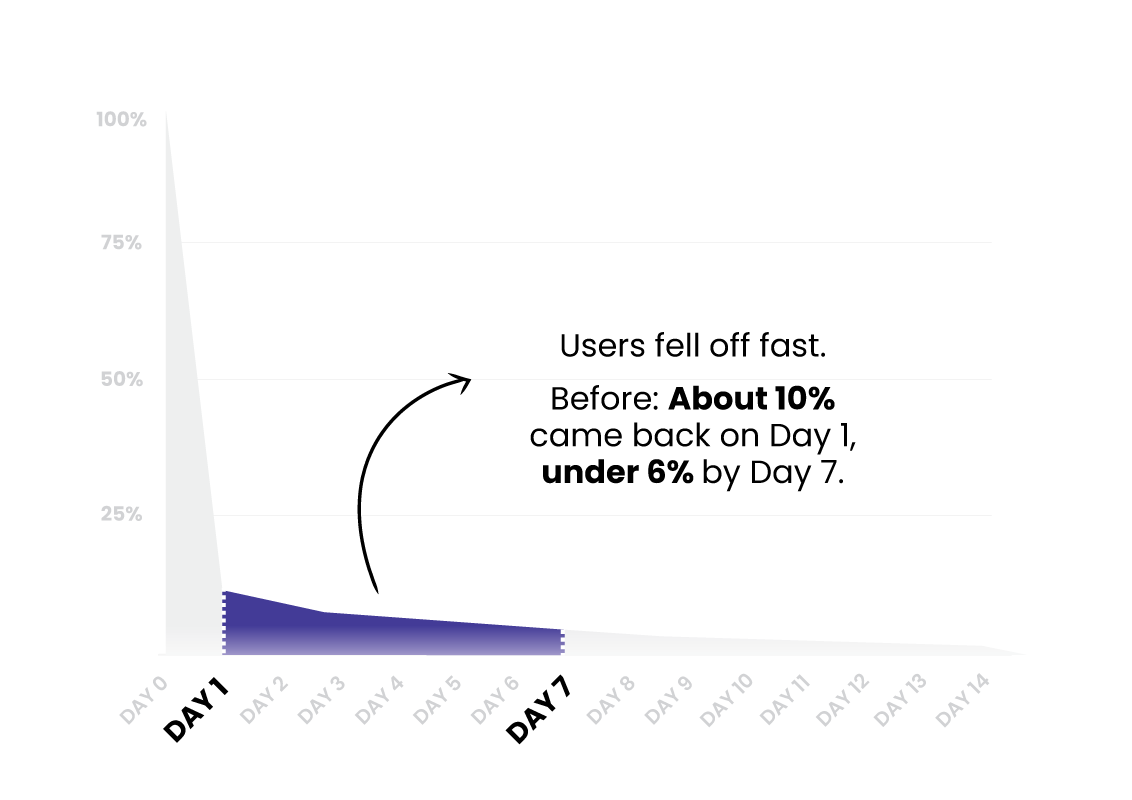
- Retention was weak: Early day return rates stayed in single digits (around 10% on Day 1
- Content felt static: No pacing or habit reinforcement.
- WhatsApp was unsustainable: Cost + user journeys outside our ecosystem.
At the same time, our research showed session timing trends: around half of all sessions happen during afternoon work/study hours, while mornings were lighter. That reinforced our design hunch: use affirmations to fill the morning gap with a calming ritual.
(Retention here means the share of people who came back on a given day after first using Affirmations: Day 1 through Day 10)

The brief: “Move Affirmations from WhatsApp into the app.” That brief treated this as just a channel switch: with success meaning users simply arrive, and it said nothing about why they’d stay.
The reframe: Treated it as a habit where success meant users come back, and people were protected through the move.
The Goal
We defined clear goals and success metrics:
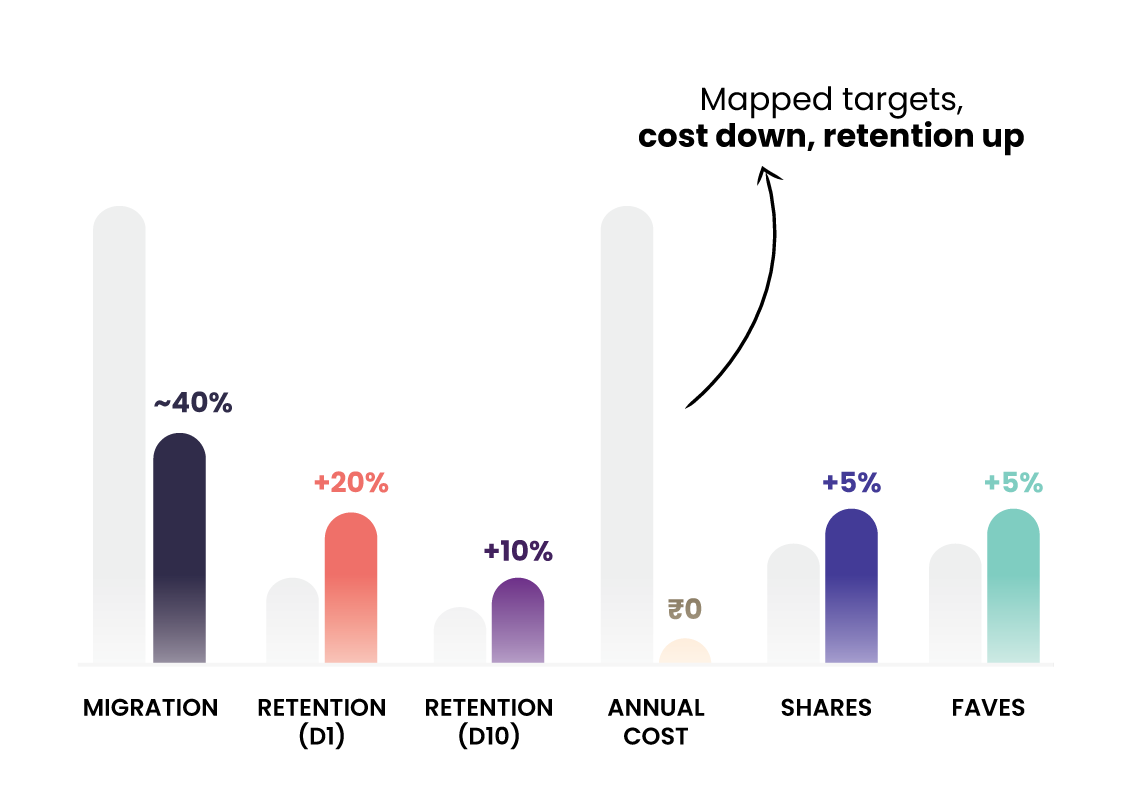
- Migrate at least 40% of WhatsApp users to the app
- Lift retention by 20% on Day 1 (from 9.8% to 11.7%) and 10% by Day 10 (relative)
- Zero WhatsApp cost within 2 weeks of phase-out
- Increase engagement: Increase in sharing and favourites
- Support corporate adoption: By 2024, corporates had grown to 45% of platform usage, so affirmations offered a low-barrier, corporate-friendly wellness entry point

First Steps
Me (product + design): Set goals and metrics in the PRD, mapped the user-state journeys, ran the data analysis and counsellor conversations, and designed the daily unlock, backgrounds and favourites.
Engineering: Daily reset logic, deep links and safe migration.
Marketing: Message templates content check.

Competitor scan: Most had reminders and favourites; none had a “daily unlock” habit loop.

User interviews: Counsellors confirmed affirmations were a “quick emotional win,” but users wanted something new each day, not a library.

Tech input: Engineers flagged feasibility for daily timers, deep linking, and migrating users safely from WhatsApp.
Four Principles
How We Built It


Designing The Daily Unlock
One new affirmation each morning; past affirmations in a growing library.
Explored calming backgrounds and typography; we kept it minimal to avoid cognitive load.
Scoped daily reset logic and storage with engineers.
Improving UI Across Devices
Old UI was static lists; new UI feels like a calming ritual.
Desktop and mobile share a visual language: space, backgrounds, subtle animations.
At completion of daily read, a popup suggests 1 to 2 related resources (journal, mood tracker).

Making Notifications Work Harder
Push notifications deep link to today’s affirmation.
Rotating morning notifications: “Quiet your mind. Open today’s affirmation.”
Missed and reactivation reminders in late afternoon the next day, aligning with platform peak usage.
Moving Off WhatsApp
This was sensitive, since users loved the familiarity.
We created a 10 day exit plan:
-
- Messages at T-10, T-5, T-1 and T-0: gentle reminders and value pitches.
- Final day message: celebrated the journey, linked to platform.
- Marketing handled templates, engineering handled deep links.


Working Process


Hurdles Along The Way
Timing: Balancing design polish with engineering feasibility (e.g., daily timers).
Deep Link work around: Deep linking of the push notifications needed to be solved.
Migration risk: Could we lose users when shutting down WhatsApp?
Results (2 Months Post-Launch)
| Metric | Target | Actual | Result |
|---|---|---|---|
| WhatsApp cost | ₹0 within 2 weeks | ₹0 | Hit |
| Favourites | +5% | +8% | Beat |
| Day-1 retention | +20% | At least +10% | Partly |
| Shares | +5% | +2% | Missed |
Costs: WhatsApp spend went from ₹2.6L a year to ₹0, and the habit moved with it.
Migration: WhatsApp users moved in-app, on par with targeted numbers of ~40%
Retention (all users): Day-1 retention improved at least 10% (relative) on the 9.8% baseline, half our goal.
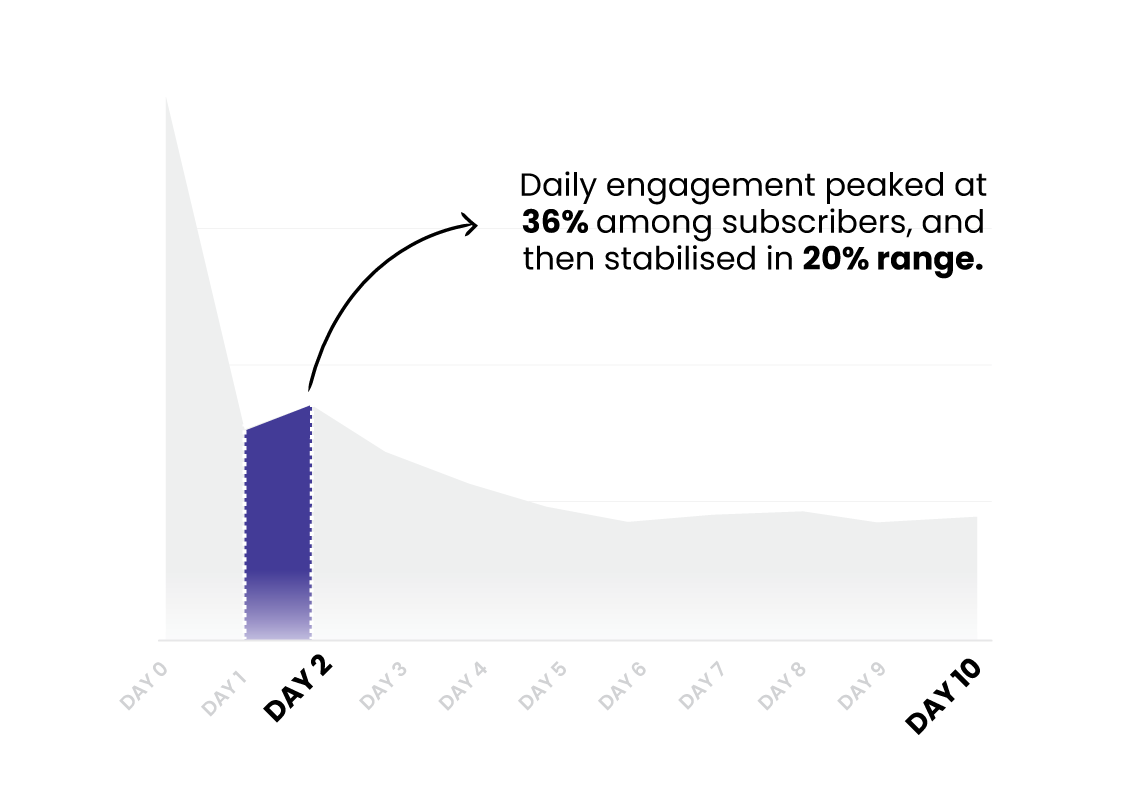
Daily opens (subscribers only): Peaked at 36% in the first days, then settled around 20%.
Favourites: +8% against a +5% target. People were making it their own, and choose to favourite.

How Users Felt
“I used to feel anxious when I would wake up, confused about how I will manage my tasks. When I subscribed for Affirmations, before talking to any person, I would open the message and feel a little more positive. I feel happier and more confident..”
“It has helped me to not be afraid of the things life puts me through.”
“Had zero energy to go for work, but affirmations started a positive chain of thoughts, that felt different, eventually it made me more enthusiastic for the day.. Thank you.”
“1 single line made me rethink a challenge as an opportunity.”
“Daily affirmations helped me to remain positive. Whenever I feel low, I read them.”
“This gives a little push in the morning!”
“Helped me undertake a few responsibilities which otherwise due to some doubt or overthinking, wouldn't be possible. A sense of confidence..”
What I’d Do Differently
Sharing missed its target: Sharing sat in the action bar rather than at the moment people felt something. I’d test a share prompt right after a favourite.
Retention reached half its goal: People who brought the WhatsApp habit kept it, but most new users still came only once. Next I’d design specifically for the first three days: what brings someone back on Day 2.
Measure the outcome, not just the habit: Engagement showed people came back. Next I’d check whether regular users saw better SUW scores, with counsellors still leading the clinical side.
Key Takeaway
Affirmations evolved from a costly, one-time feature into a daily ritual: a calming, habit-forming experience that lives inside the platform, not outside it.
It also proved a pattern: we could bring a YourDOST programme fully in-app and keep the habit, which opened the way to bringing Stepathon in-app next.